Resident journey
Enquiries, assessments, waiting lists, admission, care records, plans, transfers and reviews.
Case study · Care technology
A substantial working proof of concept for a multi-home platform spanning daily care, clinical workflows, admissions, medication, staffing, compliance, finance and management oversight.
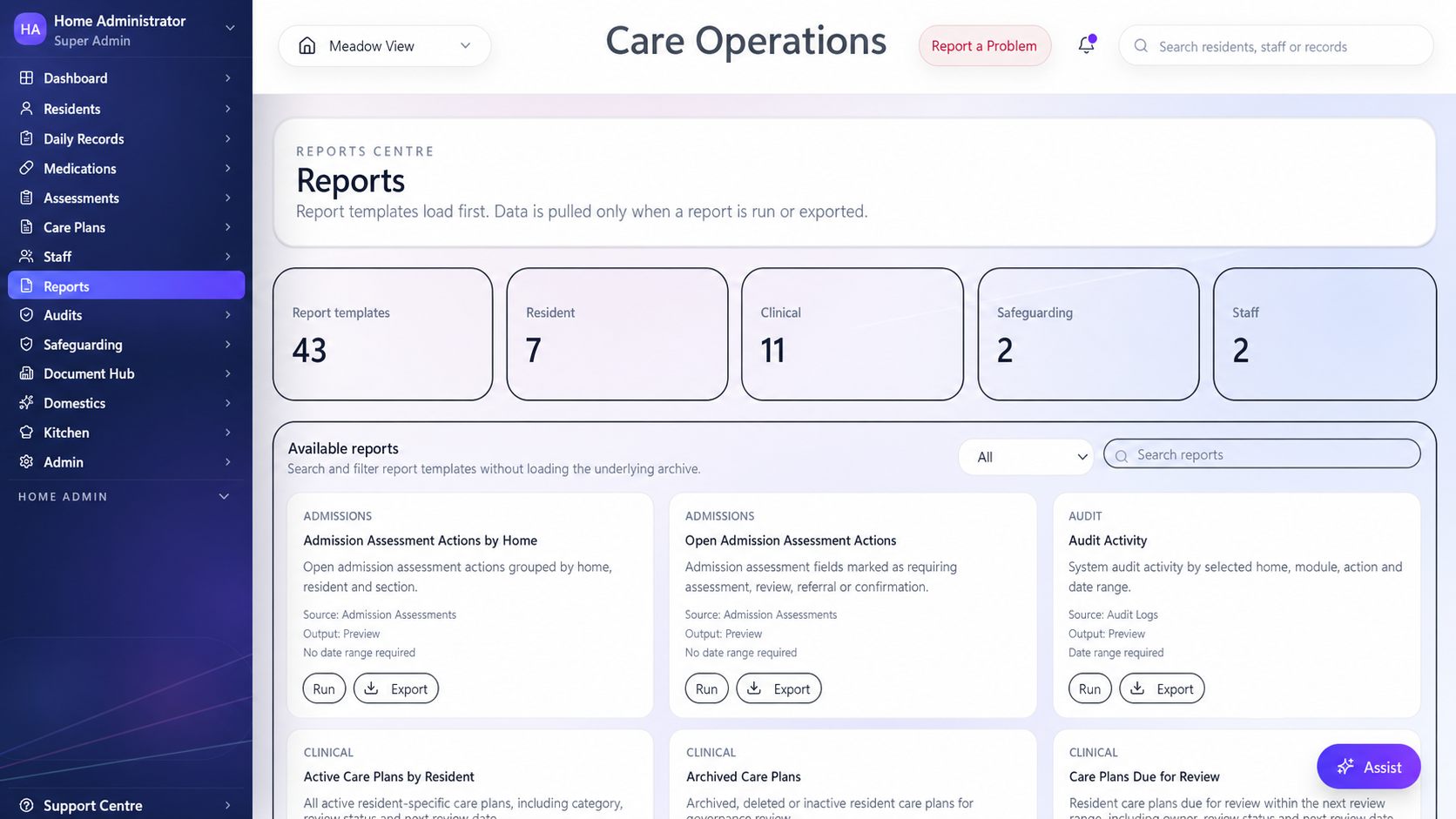
An anonymised view of a working care operations platform.
The challenge
Care providers coordinate high-stakes work across residents, staff, managers, finance teams and multiple locations.
The product brief centred on a familiar operational problem: information divided between paper files, spreadsheets, medication records, email and disconnected systems. That fragmentation creates duplicate entry, weak handovers and makes it harder for leaders to see what needs attention.
The challenge was not to digitise one form. It was to design a coherent operating model that could follow a resident from first enquiry through admission, everyday care, reviews, medication, finance and eventual transfer or discharge.
The platform
The platform brings operational, clinical and commercial workflows together while keeping screens focused for the person using them.
A shared resident record links the work. Role-aware permissions and home-level access then give care staff, nurses, managers, finance teams and group leaders the context they need without exposing everything to everyone.
Enquiries, assessments, waiting lists, admission, care records, plans, transfers and reviews.
MAR, PRN, Kardex, stock, controlled drugs, returns and second-signature workflows.
Assessments, wounds, body maps, photographs, observations and follow-up visibility.
Staff governance, communications, rooms, occupancy, safe staffing and support.
Rates, payer arrangements, billing support, documents, remittance and debt oversight.
Dashboards, reports, audits, action plans, permissions and multi-home oversight.
Design principles
The system had to support depth, traceability and governance while remaining understandable during busy shifts.
The work combined product architecture, interaction design, database-backed workflows and progressive hardening. AI-assisted features were deliberately positioned as drafting tools with human review,not as an automatic source of clinical truth.
Records, evidence and actions connect back to one resident context.
Navigation and permissions reflect real responsibilities across homes.
AI can reduce retyping, but staff review and approve important outputs.
The result
The working proof of concept demonstrates how dozens of fragmented workflows can become one coherent product.
This case study describes a working proof of concept. It does not claim unrestricted production deployment, regulatory certification or measured client outcomes.
Have a complex workflow?
JellyStorm designs bespoke platforms around real organisations, roles and processes,without forcing your team into a generic template.
Discuss your project ↗